Building a Successful Medico-Legal Practice
Independent, not an advocate. Still practising, not just teaching. What it really takes to become a medico-legal expert, and how to build a practice that lasts.
Read the article
Webinar recaps and case lessons from the PEERs programme. Practical guidance for clinicians starting or growing their expert witness work.
Medico-Legal Masterclass: From Letter of Instruction to Providing Evidence in Court
AI can now index thousands of pages of medical records and draft a chronology with page references. Courts in England, Wales and Ireland have set out what that means for the expert’s duty. Where the line sits, and why.
Read the articleIndependent, not an advocate. Still practising, not just teaching. What it really takes to become a medico-legal expert, and how to build a practice that lasts.
Read the articleSolicitors expect three things from a Condition & Prognosis report: the current condition, logical causation and a realistic prognosis. What each one asks of you, and where AI fits.
Read the articleTry a different word, or .
AI can now index thousands of pages of medical records and draft a chronology with page references. Courts in England, Wales and Ireland have set out what that means for the expert’s duty. Where the line sits, and why.

Two lever arch folders of medical records. A chronology assembled page by page. Guidelines reopened again and again to confirm the standard of care that applied at the time. For most medical experts, forming the opinion is not what consumes the hours. Everything around it is.
Artificial intelligence can now take on a significant share of that work. Used in the wrong place, it can equally compromise the integrity of a report, the expert’s credibility and the confidentiality of patient data. The question for experts is no longer whether to use AI, but where.
Not all AI carries the same risk.
Creates new content: it drafts text, summaries and arguments, and fills gaps with plausible content. It can invent facts, quotes and citations.
Works on the expert’s own material, under the expert’s own directions: transcribing dictation, extracting dates and events with page references, formatting and checking consistency. Its output is traceable to a recognised source or directly to the expert.
A practical test follows from this: who wrote this sentence, and could I defend it in cross-examination?
The Academy of Experts’ January 2026 guidance draws a clear line. Summarisation, data extraction, document interrogation and restructuring text into a chronology are allowed. Long-form drafting, complex analysis, seeking deterministic answers, uploading confidential information to public AI models and outsourcing the opinion are prohibited.
Within the allowed uses, risk rises with the amount of AI-generated content: from very low (a basic spellcheck) to high (generative AI drafting the background, narrative or facts). A higher risk level does not forbid a task. It demands closer human oversight. Where a task could sit at two levels, the prudent course is to treat it at the higher one.
AI tools can be confidently wrong, and their errors are rarely obvious. Three patterns matter most in medical records:
The rule is simple: every fact relied on goes back to its source page, and the report cites the original record, never the tool’s answer.
Patient records should never be placed into a public chatbot. Before any tool processes records, the expert should:
The expert’s own data controller duties, including ICO registration, still apply. Free versions of AI tools deserve particular caution: they may use what is entered to train their models.
Ireland’s Practice Direction HC142 already expects experts to confirm that the opinion is their own and to disclose AI use where necessary. In England and Wales, the Civil Justice Council has proposed that experts declare AI use, except for transcription and administrative tasks.
A good declaration describes the specific check the expert performed, not a general assurance. If in doubt, disclose.
Used well, AI does not dilute expert evidence. Time recovered from indexing, transcription and formatting can be reinvested where it carries the most weight: causation, confounders and a fair account of the range of opinion.
Independent, not an advocate. Still practising, not just teaching. What it really takes to become a medico-legal expert, and how to build a practice that lasts.
It usually starts with an email. A solicitor has a case, the records run to several hundred pages, and they would like to know whether you would be willing to give an opinion. Many senior clinicians receive that request at some point in their careers. Some decline. Some accept once and never again. And some discover that expert witness work becomes a second professional life: demanding, intellectually rewarding, and quietly transformative for the way they practise medicine.
If you have ever wondered whether that path is for you, this article is a place to start.
The court asks
What happened?Was it below an acceptable standard?What difference did it make?So it needs experts who are
Knowledgeable and dedicatedIndependent, not advocatesSophisticated, but not passionateHands-on practitioners, not just academicsAnd the expert gains
A more diverse careerAdditional incomeSharper risk management in your own practiceThere is no single route in, but there is a recognisable profile. Most experts have at least five years’ expertise in their field before they start. Beyond experience, the role rewards a particular temperament: genuine attention to detail, curiosity to investigate, and a passion for justice that never tips into taking sides.
Perhaps the most important habit is an analytical one, known as triangulation. An opinion should never rest on a single document. The operation note, the nursing record and the patient’s own account each tell part of the story, and a sound opinion is built where they agree, and is honest about where they do not.
The first surprise for many new experts is how firmly the role is governed. Good Medical Practice applies to expert work exactly as it applies to clinical work, and the GMC publishes specific guidance for doctors providing witness statements or expert evidence. In England and Wales, CPR Part 35 sets out the expert’s duties in civil proceedings.
Three ideas run through all of it.
You are not there to win. Winning is the lawyers’ job. Give independent, objective and honest advice.
Under CPR Part 35, it overrides any obligation to the party instructing or paying you, on either side of the case.
You are at risk when you provide this service. Have indemnity or insurance cover before accepting instructions.
It is tempting to measure success by the number of instructions. Experienced experts think about it more broadly.
Regular instructions, sustainable revenue
A credible split, close to 50:50
Valued by instructing firms
Instructions that continue for years
Financial viability is the most obvious. A practice needs regular instructions to be sustainable, and those come overwhelmingly through reputation. Word of mouth, from barristers and solicitors who have seen your work, remains the most powerful driver. Being visible helps too, but nothing replaces a report that a solicitor was glad to receive.
The claimant–defendant ratio matters more than many newcomers expect. A practice that leans heavily to one side, either side, invites a perception of bias, and you can expect to be asked about your balance in cross-examination. The aim is a credible spread of work, which means not turning away instructions that would improve it.
Respect and trust are earned slowly and lost quickly. They rest on competence, thoroughness, knowing the limits of your expertise, and honesty, including the honesty to change your mind. Experts sometimes fear that revising an opinion looks like weakness. Done early, openly and with reasons, it does the opposite.
Longevity is the long view: a practice where instructions continue, or grow, year after year, because solicitors keep coming back.
Experts do not need to be lawyers, but they do need to know where their report sits, and what the law is asking of it.
What to avoid: legal terminology and legal argument. Leave those to the solicitors.
Laparoscopic hysterectomy complicated by ureteric injury and loss of a kidney
Was the surgery itself negligent?
BolamWas she properly warned?
MontgomeryWas she offered the alternatives?
McCullochEach question is judged by a different test, and they do not all point the same way.
Most experts begin slowly, and that is fine. What changes as a practice grows is the system around the work, so that the expert’s own time is protected for the part only they can do: the medical opinion itself.
There is a final benefit that rarely appears on lists of reasons to become an expert. In the real cases discussed at our webinar, the turning points were not surgical skill alone, but documentation, communication, and whether help was sought at the right moment. Spend enough time reading other clinicians’ records and those lessons find their way into your own clinic and theatre.
Solicitors expect three things from a Condition & Prognosis report: the current condition, logical causation and a realistic prognosis. What each one asks of you, and where AI fits.
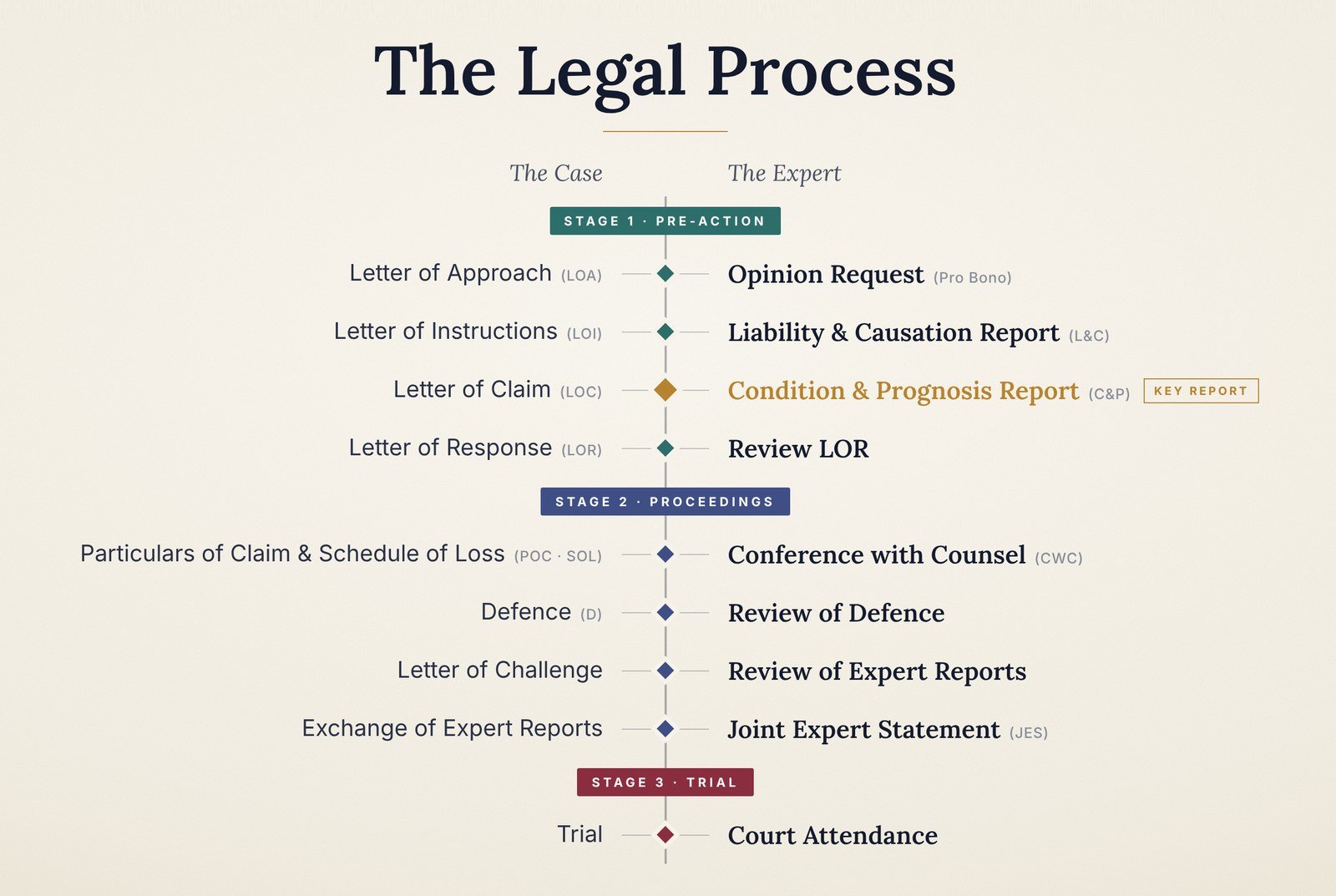
We are preparing this article in full. Subscribe below and we will email you when it is published.
Notify me